What all the wires are for
Rusty Nail is a fantasy console built on an STM32 Nucleo board: it runs PICO-8 carts natively on the microcontroller, puts a game library on an HDMI monitor, takes a Bluetooth gamepad, plays music through a proper DAC, and loads games from physical cartridges. Previous posts covered single battles - the HDMI link bring-up, this morning's crisp-pixels rework - but I have never actually shown the thing around. This is the tour: what is on the screen, what is on the bench, and why the cartridge can never be plugged into a real Game Boy.
Every console screenshot below is a pixel-perfect capture pulled straight off the running hardware over the ST-LINK debug cable (the capture tool from this morning's post), not a photo of the monitor.
The little OS
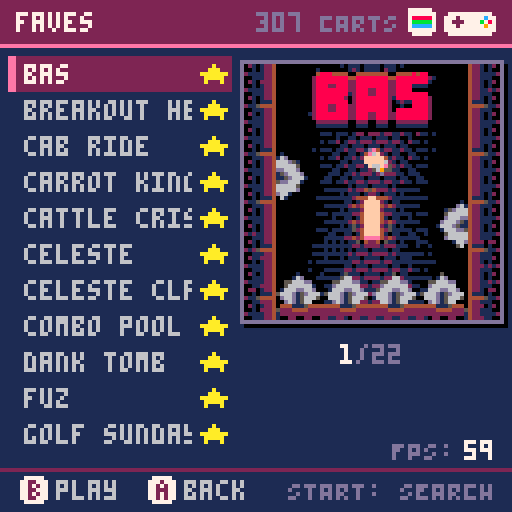
The console boots into a cart library served off the LAN: a manifest plus box-art thumbnails, fetched by the WiFi bridge. The FAVES view is home:
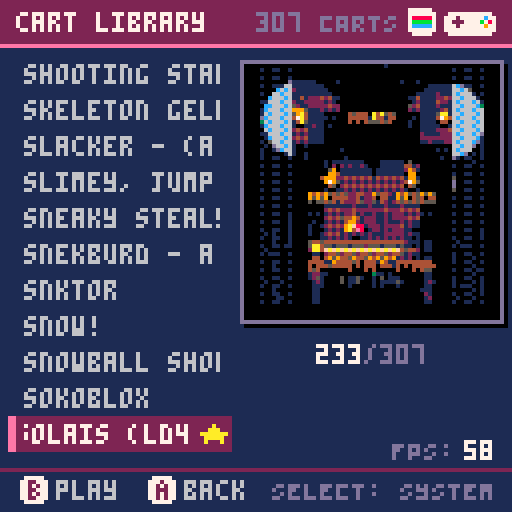
The full library is the same list unfiltered, 307 carts deep at the moment:
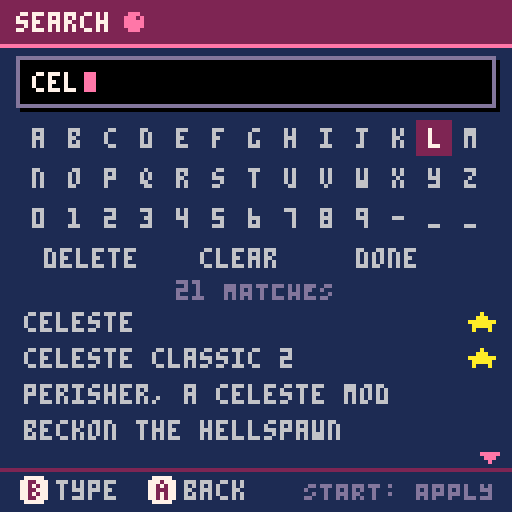
Search is a PICO-8-style on-screen keyboard with live results - three letters narrow 307 carts to 21:
The status strip top-right tells the hardware story at a glance: the cart badge lights up with a tiny colour-bar screen when a cartridge is docked, and the gamepad icon lights when the controller connects. Undock the cart and the badge drops to an outline:


Undocking also gets a toast, because a console should say goodbye:
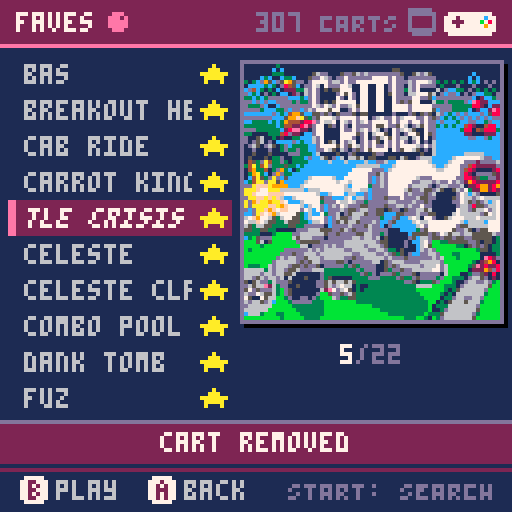
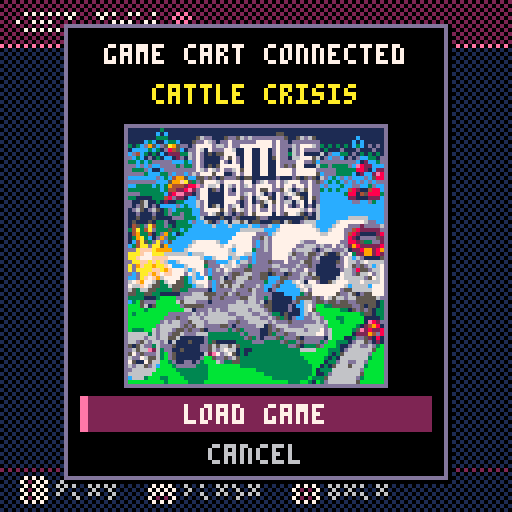
And as of this afternoon, docking a cartridge the library recognises shows the game's box art right on the insert dialog - the title is matched against the manifest (with a retry, because at boot the cart is recognised at 2.7 seconds and the manifest only lands at 3.8) and the art streams in through the same path the library grid uses:
The machine room
None of that runs on a finished product; it runs on a Nucleo-H753ZI and four breakout boards, each with one job:
- The Nucleo is the computer. A 480MHz Cortex-M7 running the whole console: the Lua VM executing the cart, the compositor, the audio synth, and every link below. No operating system, no allocator drama, one big Rust firmware.
- An Adafruit Feather RP2040 DVI is the graphics card. The H7 streams the 128x128 framebuffer over SPI at 59fps; the RP2040 scans it out as real HDMI. That link - its ground-return lessons, its clock ceiling, this morning's palette-encode rework - has generated more posts than any other wire on the bench.
- An ESP32 DevKitC is the network card and the gamepad receiver. WiFi for the manifest and box art, Bluetooth for the SN30 Pro, both multiplexed over one UART to the H7.
- A PCM5102A is the sound card. I2S from the H7's SAI peripheral, headphone-quality output, and famously allergic to switching noise on neighbouring pins - it once vetoed an entire SPI port.
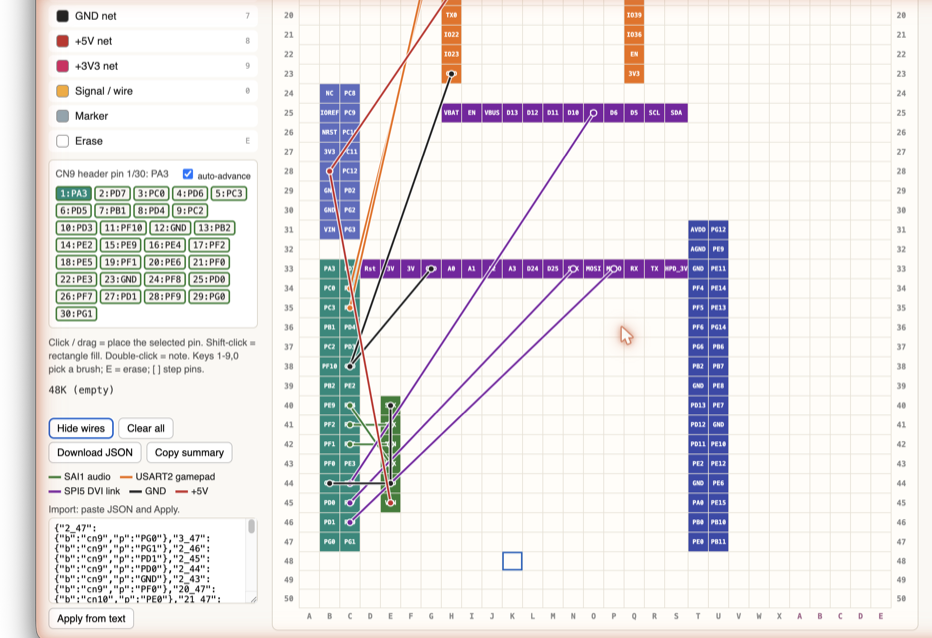
Wiring four breakouts to one Zio header field over jumpers was chaos, so the consolidation plan went through a home-made planner - an HTML grid of the actual perfboard, with every net drawn as a wire you can hover:
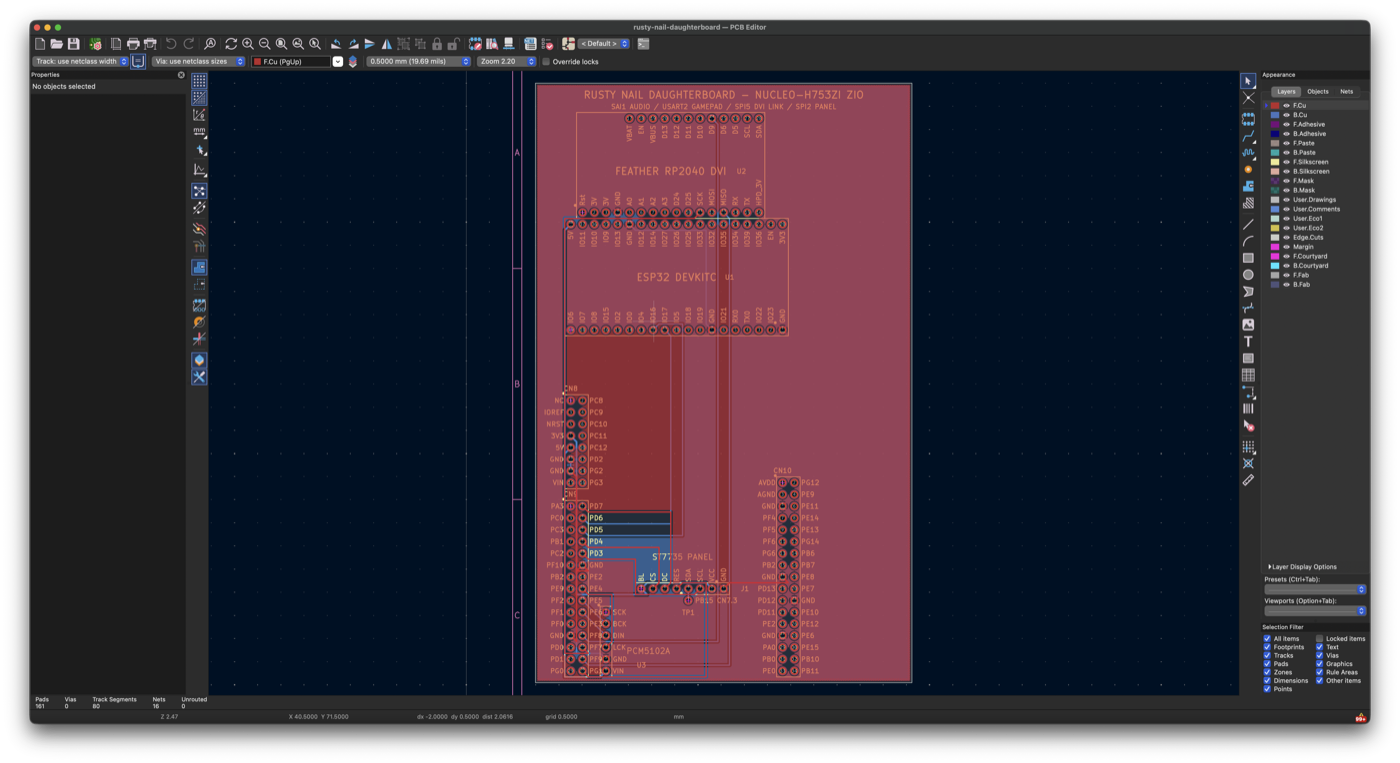
That plan became a KiCad board - a passive carrier that docks onto the Nucleo's headers and sockets all four modules, no soldering cleverness required:
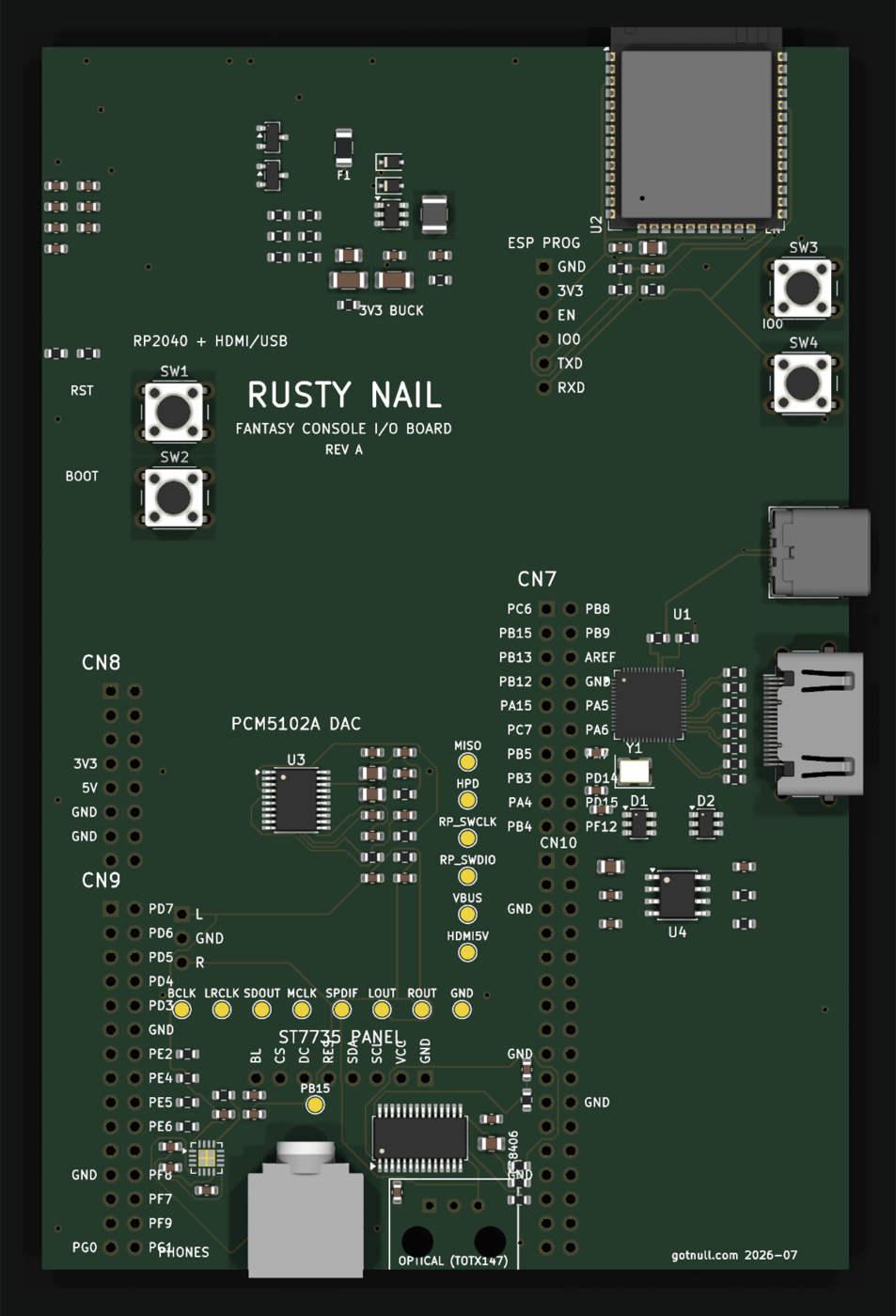
And the end-state study goes further: one board with the bare chips - RP2040 plus its flash and crystal, ESP32-WROOM module, the DAC plus a headphone jack and even optical out - no breakouts at all. It is deliberately unrouted and unfabricated for now (TMDS and USB differential pairs want a four-layer stackup and more respect than a first spin would give them), but it is the picture the bench is slowly converging toward:
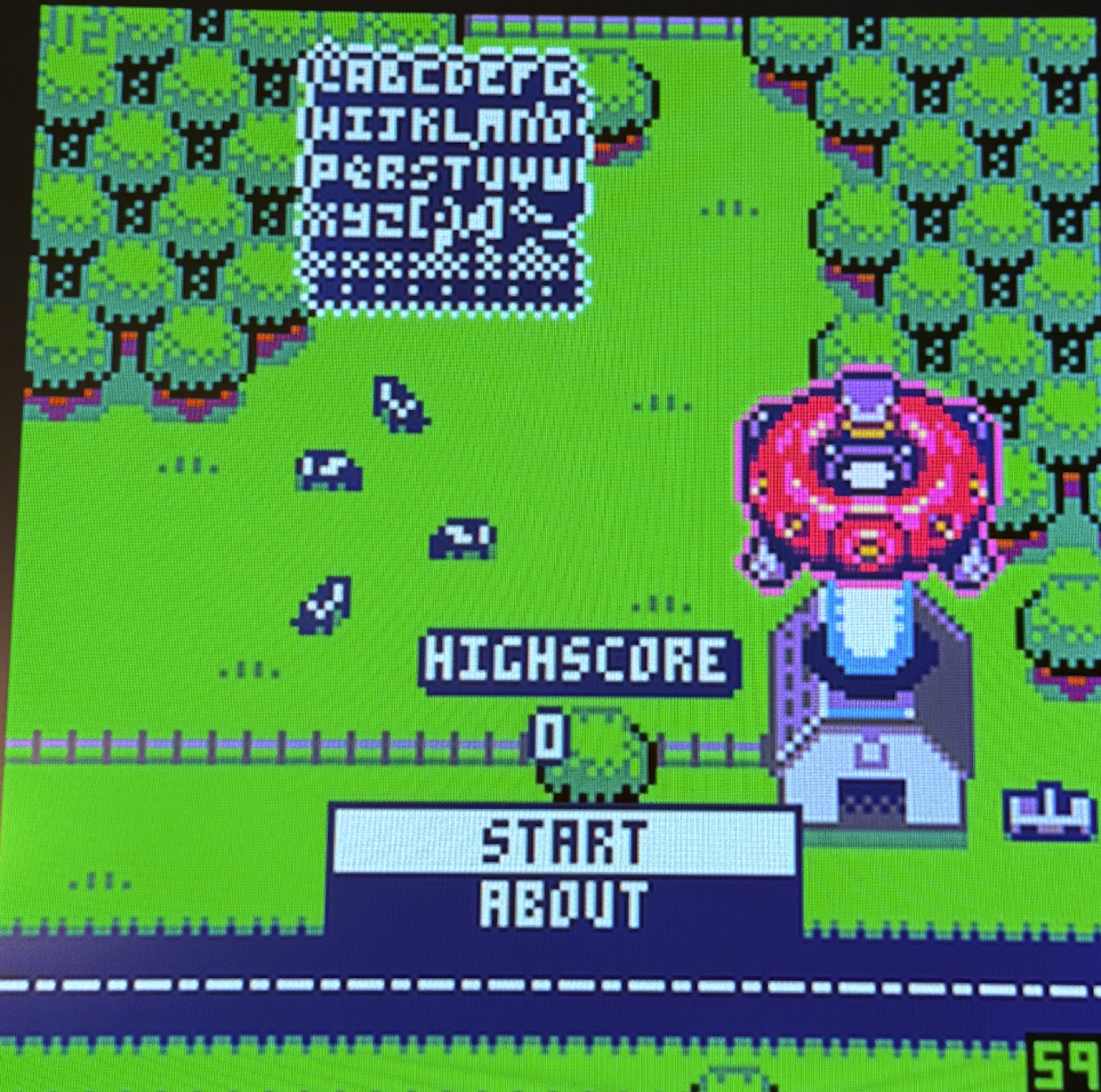
For scale, this is what the console looks like from the couch - a bench photo for honesty, mid-development, glyph debug box and all:
The cartridge
My favourite part of the whole machine. A Rusty Nail cartridge is a Game Boy cartridge shell containing no Game Boy whatsoever: inside is a W25Q128 SPI NOR flash - 16 MiB, which at PICO-8's 32 KiB ceiling is room for about five hundred games on one cart, absurd on purpose (the headroom is really for bigger cartridge formats later).
The board that makes it a cartridge rather than a chip on wires is Gekkio's GB-BRK-CART v4.0 - a passive breakout shaped exactly like a Game Boy cart PCB, bringing the 32-pin card edge out to a header. The Game Boy's parallel bus pins get remapped to SPI roles:
| GB edge pin | GB name | Rusty Nail signal |
|---|---|---|
| 1 | VCC | 3V3 (never 5V) |
| 2 | PHI/CLK | SPI SCK |
| 3 | /WR | SPI MOSI |
| 4 | /RD | SPI MISO |
| 5 | /CS | chip select |
| 6 | A0 | reserved for the v4 save chip |
| 7-31 | A1-A15, D0-D7, ... | tied to ground on the slot side |
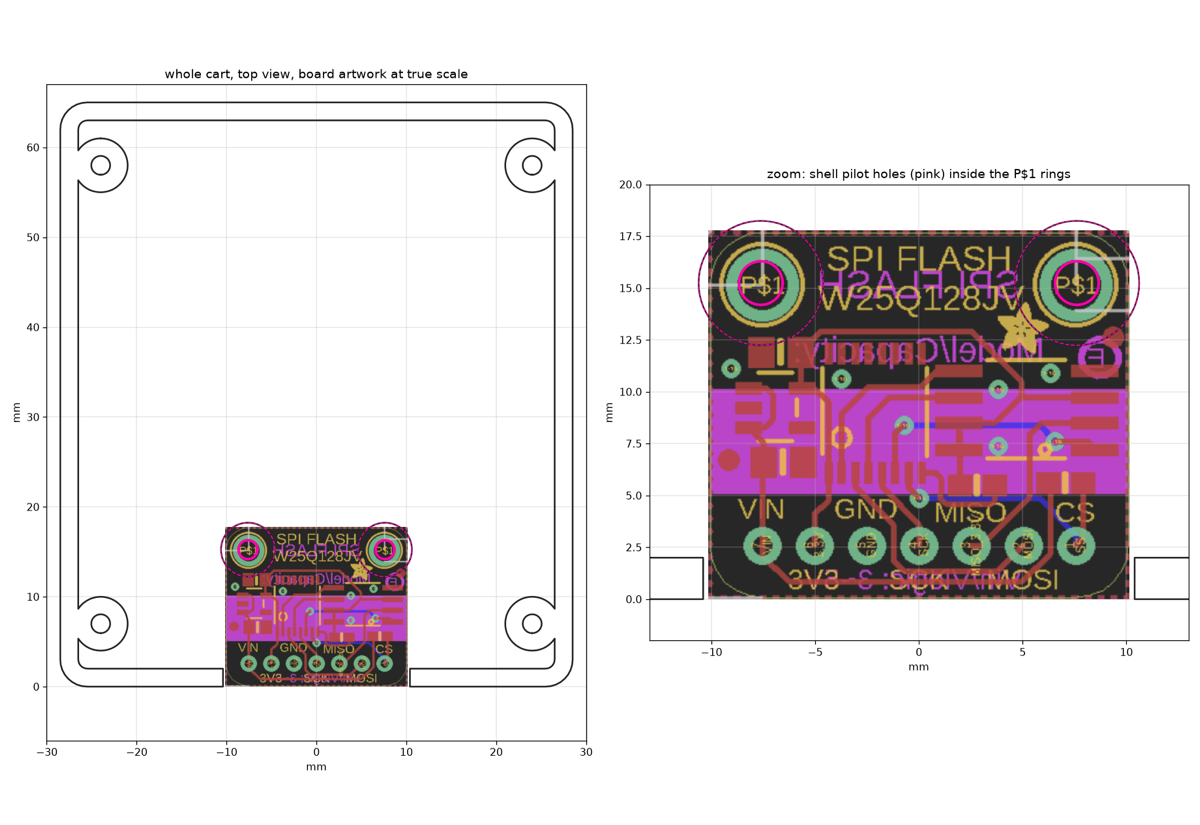
Grounding the two dozen unused lines is not laziness - it is the whole trick. SPI over a connector lives or dies on its ground return, and an edge full of grounded spares gives every signal a return path next door. The shell needed its own engineering too - the breakout plus the flash module had to sit at the right height inside a real cart shell, pilot holes and all, before the 3D-printed holder could be trusted:
Could the cart run on a real Game Boy? No, and not just as a disclaimer: the interfaces do not even intersect. A DMG expects a byte on a parallel bus a few hundred nanoseconds after presenting an address, every machine cycle; the W25Q128 says nothing until a master clocks a command and a 24-bit address into it serially. The breakout itself is fully passive - no mapper, no glue, no ROM. A real Game Boy sees grounded address lines and sulks; nothing is harmed, nothing boots. The rail is also 3V3 permanently (the flash is a 3.3V part), which is the other reason the slot and a real DMG must never exchange cartridges.
The console is its own cartridge writer. Pick any game in the library, choose FLASH, and it downloads the cart and burns it - erase, write, verify - straight from the couch:
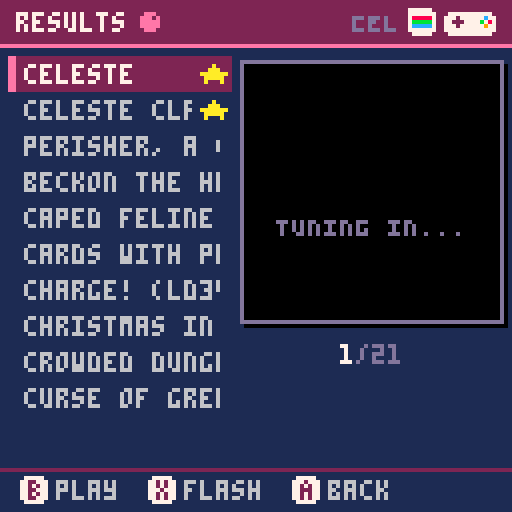
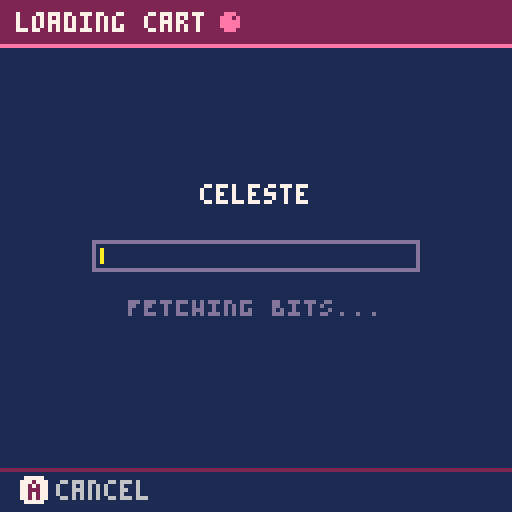
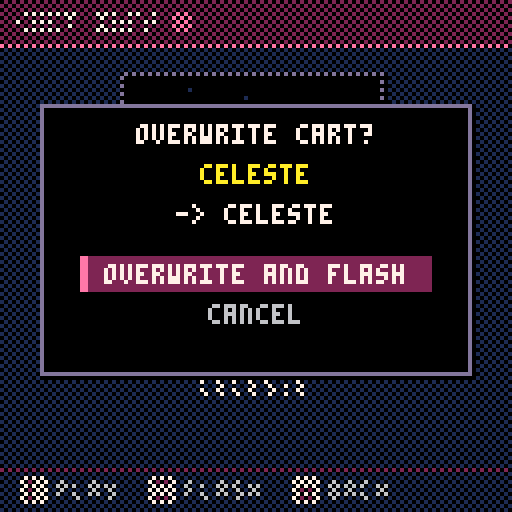
The burn itself finishes faster than a screenshot can catch it - I tried three times today, four snapshots per attempt, and every frame landed either side of the write. On a 128-square-pixel screen the erase-write-verify of a 35 KB game is simply over before the next capture window opens. I have decided to be proud of that instead of annoyed.
What is next
The cartridge roadmap has one entry left: a small FRAM chip on the cart for save data - byte-writable, no sector erase, so a game can save without ceremony - plus maybe a cart identity for the dialog even when the game is not in the library. An SD slot for a purely offline library is sketched. And the 3D-printed cartridge holder just hit its first physical revision, which deserves photos of its own once it has earned them.
The console in this post is a breadboard and four breakouts pretending very hard to be a product. Some evenings, from the couch, with the pad in hand and a cart clicking into a printed shell, the pretence is completely convincing.